
WALLPAPER IS BACK!!! YAY!
- Feb 14, 2017
- 4 min read

Yes, can you believe it….wallpaper is coming back in style. Designers never really stopped using wallpaper to add texture and style to a room, but homeowners pretty much turned away from it in the 1980s and into the 90s. What was in back then if it wasn’t wallpaper? Neutral color schemes and flat paint….still popular today in fact. Only in the last year or two have I really started to get more requests from clients wanting to put wallpaper back on their walls. But don’t get me wrong, it’s ………
NOT Your Grandma’s Wallpaper
I know, I KNOW, you’re probably trying to avoid living nightmares of your grandmother’s avocado-colored, flower print wallpaper that adorned the bedroom that YOU had to sleep in. But FORGET about this tacky wallpaper. Modern day wallpaper features fresh colors, textures and patterns.


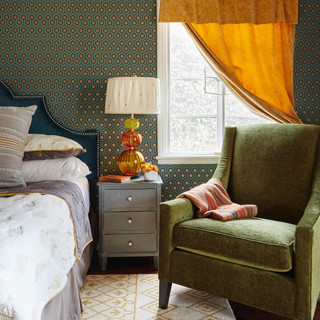


(Photos courtesy Susie Herr Fermine Studios and Bassett Furniture)
With today’s wallpaper, you can go as bold or understated as you’d like. Geometric shapes are big right now, as are modern versions of floral and botanical prints. Metallic and textured, rustic wood and stone wallpapers are also popular. You can even buy wallpaper that mimics the look of fabrics such as leather and grass cloth.
Modern wallpaper is much easier to use than in years past. Most come pre-pasted which means no more sticky paint rollers, no more splotches of glue on the floor and work table, and no more drippy glue in your hair and on your hands!! Today’s wallpaper is lighter, and it goes up easier. More importantly, it’s much easier to remove. (We all have horror stories about spending days scraping off layers and LAYERS of old wallpaper, right?)
Finally, the way we use wallpaper has changed the most. Instead of papering an entire room, it’s common now to use wallpaper as an accent for just a single wall, just in the bathrooms, a down a long hallway or sometimes even on a ceiling. Using wallpaper sparingly creates depth and interest without overwhelming a space. Remember…..LESS is more! But of course, if you find a print you love and you’re bold enough to cover the entire room, by all means, go for it. I HAVE!
COST AND INSTALLATION
You can buy clearance-bin wallpaper at most big box stores, or can shop online for discount wallpaper warehouses, or even find vintage or discontinued wallpaper sources on line, or you can buy designer wallpaper at your local design centers. But today’s wallpaper is not for the skimpy wallet….you’ll expect to pay upwards of $100 or more per roll at some design centers. However, if you shop wisely, you will find out the vast majority of wallpaper falls somewhere in between, $25 to $50 per single roll. But here’s one buyer’s beware caveat….as we all find out, wallpaper is sold in DOUBLE rolls…so multiple the cost per single roll by 2. It can be pricey but the overall look is stunning and well worth the expense up front. You’ll enjoy the effects of the wallpaper for years to come.
To figure out approximately how many rolls you need for a room, multiply the width of the space by its height and divide by 40 and then round up to the next whole number. A standard double roll covers 56 square feet of wall space, but it’s a good idea to divide by 40 to leave some room for error. Please, please make sure you allow for what’s called “pattern repeat”. Today’s modern wallpapers can have up to 20” or more as a pattern repeat which should all be figured into determining how many rolls of wallpaper to purchase. When you purchase wallpaper, make sure you order and receive wallpaper all from the same color lot. Different printing runs (lots) of wallpaper can end up with varying colors. Make sure to order rolls all from the same dye lot.
Professional installation will increase the project cost considerably, but it’s a good idea if you’ve never hung wallpaper or if you’re not comfortable with do-it-yourself projects. Hanging wallpaper is tricky – it can be tough to match the seams or avoid bumps and bubbles. Budget about $5 per square foot of wall space for professional installation.
If you decide to tackle the project yourself, there are plenty of online resources that provide step-by-step guidance.
HOW TO CHOOSE YOUR WALLPAPER
The first step is deciding your colors and then selecting your material. See my earlier blog about how to choose your favorite colors. Most of us think of the traditional vinyl material when we envision wallpaper, and that is still readily available and I would suggest a vinyl in a bathroom or kitchen possibly where water and moisture are present on a daily basis. But now you can also choose embossed (textured), fabric or foil (metallic) varieties. Keep in mind that heavier, textured paper will do a better job at covering flaws in the wall (cracks, nail holes, sloppy drywall mudding) than lighter varieties such as foil. The thinner the paper, the more likely you will see all kinds of bumps and wrinkles unless the walls are sanded smooth.
Next, you’ll want to choose a pattern. Obviously, DUH, it’s important to pick a pattern that you like. Don’t be afraid and go bold with color and pattern for BIG impact. But if you’re doing your own wallpaper hanging, it’s also important to pick a pattern that is not too difficult to match at the seams....that pattern repeat I mentioned a few minutes ago. Also, keep in mind that patterns can be used to create visual tricks. Vertical stripes make ceilings and overall room appear higher, for example, while horizontal stripes make rooms appear wider.
Lastly, you want to think about the type of adhesive. There are three options: pre-pasted wallpaper that requires water to activate the paste; self-adhesive paper that you simply peel and stick; or non-pasted wallpaper that requires application of a separate sticky adhesive that I mentioned before. Pre-pasted and self-adhesive varieties are far easier to remove. And….more often than not, they can be peeled right off again.


Comments